Residential License # 890459
Commercial License # 3667

Opening Hours 9:00 am to 6:00 pm


Call Us Today!
Residential License # 890459
Commercial License # 3667
Opening Hours 9:00 am to 6:00 pm
Call Us Today!

Commercial parking lot and pavement demolition involves removing asphalt or concrete surfacing, often down through a compacted sub-base that has to be addressed before new paving goes in. The process differs from typical slab demolition because of the scale involved and the milling or full-depth removal equipment required. Property owners repaving or redeveloping a commercial lot need a plan for base condition, drainage, and debris volume before crews arrive.
A cracked, potholed parking lot is one of the first things customers notice about a commercial property, and full removal is sometimes the only fix once patching stops working. Parking lot demolition covers more ground, literally, than a typical building teardown, and it comes with its own set of decisions around milling versus full removal, base repair, and drainage. Business owners across the New Orleans area planning a repave or redevelopment project run into questions that don’t come up on a standard building job.
Before diving into specifics, it helps to see how pavement removal fits into the broader range of work covered on the commercial demolition services page, since parking areas are often part of a larger site redevelopment rather than a standalone project.
Milling grinds off the top layer of asphalt while leaving the base intact, and works when the sub-base is still structurally sound. Full removal takes the pavement down to bare ground or existing sub-base, which is necessary when cracking has traveled through the full depth of the surface or when drainage problems point to a base failure. A pavement engineer or an experienced demolition crew can usually tell the difference by looking at crack patterns, particularly alligator cracking that signals base-level deterioration rather than surface wear.
Concrete parking areas, common at loading docks and heavy-traffic commercial sites, are typically removed in full rather than milled, since concrete does not respond to milling equipment the way asphalt does.
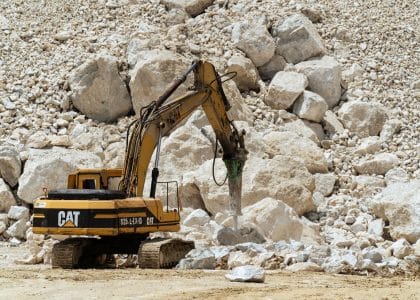
Milling machines, asphalt saws, and heavy excavators with breaker or ripper attachments each play a role depending on the surface type and removal method chosen. A cold planer or milling machine is used for surface-only removal, while full-depth asphalt or concrete demolition typically calls for excavators fitted with hydraulic breakers to fracture the material before loadout. Site size determines whether one machine can handle the job or whether a crew brings multiple pieces of equipment to keep the timeline reasonable.
Access matters here too. A parking lot still partially in use during a phased renovation needs equipment staged and sequenced differently than a fully closed site being cleared for redevelopment.

Most removed pavement material is crushed and recycled rather than landfilled. Recycled asphalt pavement and crushed concrete both have secondary uses in new base material, which keeps disposal costs down and reduces landfill volume on a project that can otherwise generate a significant amount of debris. A crew that recycles pavement material as standard practice, rather than defaulting to landfill disposal, usually reflects that in project pricing.
For property owners also removing structures as part of the same redevelopment, the site’s concrete demolition methods guide covers how slab and foundation removal is approached separately from surface paving work.
Existing storm drains, catch basins, and grading have to be protected or rerouted during removal, since a parking lot’s drainage design doesn’t disappear just because the surface is gone. Crews mark and protect drainage infrastructure before demolition begins, and a full-depth removal project often reveals drainage issues that weren’t visible under an intact surface, such as a collapsed pipe or undersized catch basin. Addressing these during demolition, rather than after new paving is poured, saves a second round of cutting into fresh pavement later.

Pricing depends on square footage, removal depth, material type, and how much recyclable material offsets disposal costs. A milling-only project is generally less expensive per square foot than full-depth removal, since less material is disturbed and hauled. Concrete removal tends to cost more than asphalt removal per square foot due to the added breaking time required. Site owners should get a quote that specifies removal method, depth, and whether base repair is included, since a low bid that skips base evaluation can lead to premature failure of the new surface.
Phasing splits a parking lot into sections so part of the property stays open to customers or tenants while another section is under demolition. This approach requires more coordination than a single continuous teardown, since equipment staging, temporary signage, and traffic flow all have to be planned around whichever section remains open. Retail centers, medical offices, and other businesses that rely on steady foot traffic often request phasing even though it can extend the overall project timeline compared to closing the entire lot at once.
Coordinating phased work also means scheduling the noisiest and dustiest portions of demolition during lower-traffic hours where possible, which keeps disruption to customers and tenants to a minimum without slowing down the underlying construction schedule.
Once old asphalt or concrete is out, the exposed base typically needs grading, compaction testing, and sometimes new sub-base material before new paving goes down. A base that failed under the old surface, whether from poor original compaction or years of water infiltration through cracks, has to be corrected at this stage or the new pavement will develop the same problems within a few years. This is where a full-depth removal project earns its extra cost over a milling-only approach, since it gives a paving contractor the opportunity to fix underlying issues rather than build a new surface over a compromised base.
Asphalt paving generally requires warmer temperatures to cure properly, while demolition and removal work itself can happen in most weather short of heavy rain. Louisiana property owners planning a full lot replacement should factor in that the removal phase can proceed nearly year-round, but scheduling the actual repaving for warmer months often produces a better long-term result. Coordinating removal timing with a paving contractor’s schedule avoids a gap where an exposed sub-base sits open to rain and erosion for longer than necessary.
A typical mid-size commercial lot takes a few days to a week depending on square footage, removal depth, and whether the site stays partially open during work. Larger retail or industrial lots can take longer.
Sometimes an overlay works if the existing base is sound and cracking is limited to surface wear. Once alligator cracking or base failure shows up, an overlay just telegraphs the same cracks through the new layer within a year or two.
Recycled asphalt pavement is commonly used as base material and, when properly processed, performs well in that role. It’s not typically used as the final wearing surface, but it reduces the amount of virgin material and landfill space a project requires.
Not always. Many projects are phased so part of a lot stays open for customer parking while another section is under demolition. This depends on lot size and layout, and it’s worth discussing during the estimate.
This depends on the contract, but a reputable demolition crew flags drainage issues like a collapsed storm line as soon as they’re found rather than paving over the problem. Property owners in parishes like Jefferson Parish should confirm this expectation before work begins.
Full-depth removal, milling, and base repair all call for different equipment and timelines. A site walkthrough gives an accurate picture of what a specific lot needs before a schedule is set.
Get a commercial estimate or call (504) 732-9194 to discuss a parking lot or pavement project.
 TurnKey Demo Team
  Aug 9, 2026