Residential License # 890459
Commercial License # 3667

Opening Hours 9:00 am to 6:00 pm


Call Us Today!
Residential License # 890459
Commercial License # 3667
Opening Hours 9:00 am to 6:00 pm
Call Us Today!

Industrial demolition projects in New Orleans operate under strict safety standards that protect workers, the public, and the environment. Understanding these standards helps facility owners evaluate contractors, maintain compliance, and ensure that every phase of demolition is executed responsibly.

Industrial demolition is among the highest-risk activities in the construction industry. Large structures, heavy materials, hazardous substances, and powerful equipment create an environment where safety cannot be treated as an afterthought. At TurnKey Demo Team, safety is the foundation of every industrial demolition project we take on in the New Orleans area. Proper safety planning protects our crews, your property, neighboring facilities, and the surrounding community.
The consequences of inadequate safety protocols in industrial demolition are severe. Structural collapses, hazardous material exposure, equipment accidents, and environmental contamination can all result from cutting corners on safety. These incidents cause injuries, regulatory penalties, project shutdowns, and long-term liability. Every dollar invested in proper safety planning pays for itself many times over.
The Occupational Safety and Health Administration (OSHA) sets the baseline safety requirements for demolition work in the United States. OSHA 29 CFR 1926 Subpart T covers demolition-specific requirements, including engineering surveys before work begins, removal of utilities and hazardous materials, protection against premature structural collapse, floor and wall opening protection, stairway and passageway protection, and debris handling and removal procedures.
For industrial demolition, additional OSHA standards frequently apply. Subpart CC covers crane and derrick operations. Subpart Z addresses hazardous substance exposure limits. Subpart AA covers confined space entry requirements. These overlapping standards create a comprehensive safety framework that qualified contractors must implement on every industrial project.
OSHA requires a written engineering survey before any demolition begins. For industrial facilities, this survey is especially critical. A qualified engineer examines the structure to determine the condition of framing, floors, walls, and foundation systems. The survey identifies potential hazards including weakened structural elements, stored energy systems (pressurized pipes, electrical systems, chemical tanks), underground voids or tunnels, and connection points with adjacent structures.
The engineering survey forms the basis of the demolition plan, which specifies the sequence of removal, equipment positioning, exclusion zones, and contingency procedures. This plan must be developed before the first piece of equipment enters the site. Without it, crews would be working blind in a high-risk environment.
Industrial facilities in New Orleans, particularly those along the river corridor and in industrial zones throughout Jefferson and St. Bernard parishes, commonly contain regulated hazardous materials. Asbestos insulation on pipes and boilers, lead-based coatings on structural steel, PCB-containing electrical equipment, mercury in switches, gauges, and lighting, and chemical residues in tanks and processing equipment all require specific handling protocols.
Before demolition begins, a comprehensive environmental assessment identifies all hazardous materials present. Licensed abatement contractors then remove or encapsulate these materials according to EPA and Louisiana DEQ regulations. Air monitoring during abatement ensures that workers and the public are not exposed to harmful concentrations. Our hazardous material removal services meet all state and federal requirements for industrial settings.
Working at height is inherent in industrial demolition. Structures may reach 50, 100, or more feet tall. OSHA requires fall protection for workers at heights of six feet or more in construction and demolition. This includes personal fall arrest systems, guardrails, safety nets, and controlled access zones. Workers operating on partially demolished structures must be protected against floor collapses, wall failures, and falling objects from above.
Maintaining structural stability during the demolition sequence is equally important. Removing elements out of sequence can cause unplanned collapses that endanger everyone on site. The demolition plan specifies the exact order of removal to maintain stability at every stage. Structural monitoring, including visual inspection and, in some cases, electronic monitoring, tracks the structure’s behavior throughout the demolition process.
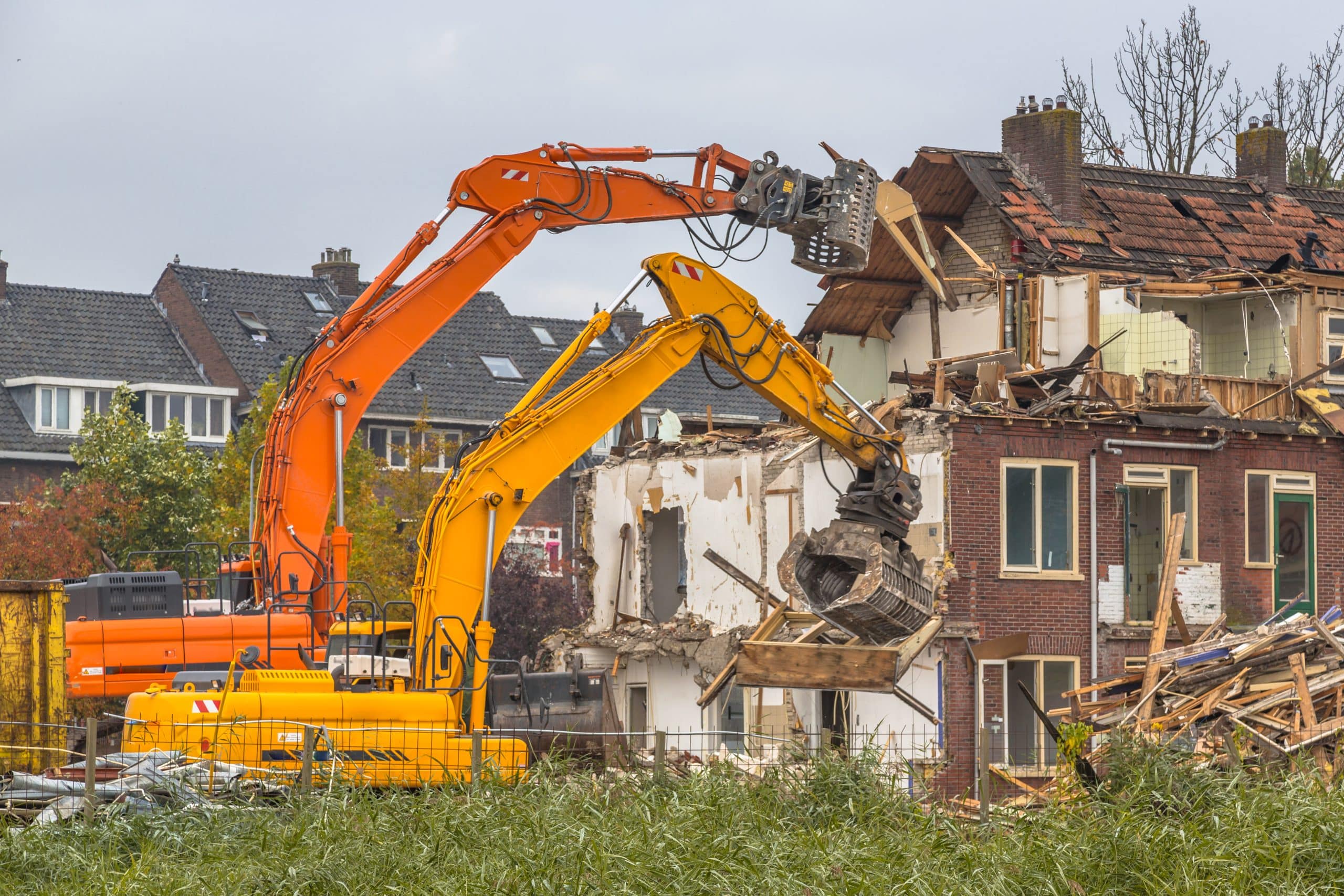
Industrial demolition requires heavy equipment operated by highly trained personnel. Excavators, cranes, high-reach demolition machines, and specialized attachments all require operators who are certified and experienced with that specific equipment type. OSHA requires that crane operators hold nationally recognized certifications. Equipment must be inspected daily before use, and maintenance records must be current.
Exclusion zones around operating equipment protect ground-level workers from being struck by machines or falling debris. Signal persons coordinate between operators and ground crews. Communication systems, including radios and visual signals, keep everyone informed during active demolition operations. For a broader view of how industrial projects differ from other demolition types, read our industrial demolition guide for facility owners.
Industrial demolition must protect the surrounding environment. Dust control measures, including water sprays, misting systems, and enclosed debris chutes, prevent particulate matter from spreading beyond the site boundary. Stormwater controls, including silt fencing, sediment basins, and erosion control blankets, prevent contaminated runoff from reaching waterways. This is particularly important in New Orleans where proximity to the Mississippi River, Lake Pontchartrain, and various bayous and canals makes environmental protection a top priority.
Air quality monitoring at the site perimeter verifies that demolition activities are not causing harmful emissions. Noise monitoring may also be required, especially when industrial demolition occurs near residential areas. Site remediation after demolition addresses any remaining soil or groundwater contamination, returning the property to a condition suitable for its next use.
Industrial demolition workers must receive specific safety training before working on site. This training covers hazard communication (understanding chemical and material hazards), respiratory protection (proper use of respirators and air-monitoring equipment), confined space entry procedures, fall protection systems and procedures, equipment-specific operation training, and emergency response and evacuation procedures. Training records must be maintained on site and available for inspection by OSHA compliance officers.
As the facility owner, you are not directly responsible for implementing demolition safety protocols; that is your contractor’s job. However, you are responsible for selecting a qualified contractor with a strong safety record, providing accurate information about your facility’s history and contents, ensuring the site is properly vacated and secured before demolition begins, and maintaining insurance coverage throughout the project.
Contact TurnKey Demo Team or call (504) 732-9194 to discuss your industrial demolition project. Safety is not just a priority for us; it is a non-negotiable standard built into every project we manage. For related topics, explore our articles on the commercial demolition process, preparing for commercial demolition, and concrete demolition versus removal.
Look for OSHA 30-hour construction safety certification for supervisors, OSHA 10-hour for workers, crane operator certifications from NCCCO or equivalent, and any state-specific licensing. A strong contractor will also have an Experience Modification Rate (EMR) below 1.0, indicating better-than-average safety performance.
The demolition contractor is primarily responsible for implementing safety protocols on the job site. However, the facility owner has a duty to provide accurate site information, select a qualified contractor, and ensure the site is properly prepared. OSHA can cite both the contractor and the site owner for safety violations.
OSHA compliance officers can issue citations ranging from other-than-serious to willful violations. Penalties can reach over $150,000 per willful violation. Serious violations can result in work stoppage orders until the hazard is corrected. These penalties underscore the importance of strict safety compliance.
New Orleans weather creates specific safety challenges. High heat and humidity increase the risk of heat-related illness for workers. Thunderstorms and high winds require work stoppages, especially for crane operations and high-reach equipment. Heavy rain affects site conditions and can create unstable ground. Contractors must monitor weather conditions daily.
Yes. Safety plans include exclusion zones, dust and debris containment, vibration monitoring, and traffic management to protect neighboring properties and the public. Pre-demolition surveys of adjacent structures may be conducted to document existing conditions and detect any demolition-related impacts.
Air quality monitoring at the site perimeter tracks particulate matter and, when applicable, specific contaminants like asbestos fibers. Stormwater monitoring ensures runoff does not carry contaminants off site. Noise monitoring may also be conducted. All monitoring results are documented and available for regulatory review.
 TurnKey Demo Team
  Jun 2, 2026